 Calvap
Rosemary oil · 5 min read
Rosemary oil: essential or infused
The same name covers two very different products: a powerful concentrate and a scented oil. How to tell which one you have, what the only serious study says, and the precautions to take.
Calvap editorial team · Updated · 4 sources
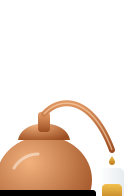
You’ve seen the video: a few drops of rosemary oil massaged into the scalp, and fuller hair six months later. You go looking for it and find two bottles with the same name. One is tiny, with a dropper, and smells very strong. The other is a big bottle of golden oil with a faint scent.
They aren’t the same product. And that changes everything: what’s inside, how to use it, and what you can expect from it.
Two products, one name
The small bottle is essential oil. It’s usually made by steam distillation: in a still, steam passes through the plant, carries off its scented compounds, then condenses. The oil then separates from the water, the way oil floats on top of a salad dressing2.
It takes a lot of plant to make a little oil. The yield varies hugely from one plant to another; the ANSM, the French medicines agency, gives the example of lemon balm: 10 kg of fresh leaves for about 1.5 g of essential oil2. What comes out of the still is a concentrate. The ANSM points out that essential oils are meant to be used diluted, and that when sold neat they can be toxic if misused, especially for children2.
The big bottle is a vegetable oil, often called an infused oil or macerate. Rosemary isn’t a seed that yields oil, like sunflower or olive. So this “rosemary oil” is an ordinary oil (sunflower, olive, almond, castor…) in which rosemary has been steeped, or to which a little essential oil has been added. It’s far less concentrated.
How to tell which one you have
The name on the front isn’t enough. Turn the bottle over and read the ingredients list, which always runs from most to least abundant.
- The first ingredient is a vegetable oil (Helianthus annuus for sunflower, Olea europaea for olive, Ricinus communis for castor), with rosemary (Rosmarinus officinalis) further down: it’s an infused oil or a diluted blend.
- The list contains only Rosmarinus officinalis, often followed by “leaf oil”: it’s pure essential oil.
For an essential oil, also look for the origin or type on the label (Spain, Morocco, Tunisia). You’ll see why.
What the essential oil contains
Rosemary essential oil isn’t a single substance. It’s a mix of dozens of molecules, two of which are closely watched: 1,8-cineole (also called eucalyptol) and camphor. The ANSM lists both among the constituents with a risk of neurotoxicity, meaning toxicity to the nervous system3.
How much they contain depends on where the plant comes from. The Pharmacopoeia, the official book of quality standards, distinguishes two types of rosemary, with very different ranges3.
About twice as much depending on origin: two “rosemary” bottles aren’t equal.
According to the ANSM, essential oils containing camphor or eucalyptol have been linked to serious neurological side effects (seizures, drowsiness, agitation), especially in children3. This risk concerns the essential oil, not a lightly scented infused oil. One more reason to know what’s in your bottle.
What the 2015 study showed
Most articles on the subject point to the same trial, published in 20151. A hundred people with androgenetic alopecia, the inherited form of hair loss, were randomly split into two groups of 50. The first applied rosemary oil, the second a 2% minoxidil lotion, for six months. Hair counts were measured on standardised photos taken at the start, at 3 months and at 6 months1.
3 monthsno notable change in hair count, in either group
6 monthshair count had risen in both groups, with no difference between them
Panahi et al., 2015, 100 people with androgenetic alopecia1
Scalp itching increased in both groups, more often with the minoxidil lotion than with rosemary. Dry hair, greasy hair and dandruff didn’t change notably1. The authors conclude that rosemary oil is effective for this type of hair loss.
Where the study falls short
The result is encouraging, but it rests on very little.
First, there was no placebo group, meaning people applying an oil with no rosemary in it. Yet shedding varies on its own, for example with the seasons. Without a control group, there’s no way to know how much of the gain comes from rosemary and how much from the simple passing of time.
Next, the abstract reports a “significant” increase without saying how big. Significant means the gain probably isn’t down to chance, not that you’d see it in the mirror.
The study abstract doesn’t say either whether it was diluted essential oil or infused oil. So there’s no way of knowing which bottle reproduces what was tested.
Finally, it’s a single trial, of 100 people, in one type of hair loss. It says nothing about shedding after giving birth, a deficiency or stress. That’s thin ground for certainty, as with many of the tips that do the rounds on social media.
Using it safely
If you want to try it, a few rules apply mainly to the essential oil, and nothing stops you following them with an infused oil too.
Never apply it neat. DermNet, the New Zealand dermatology reference site, advises against putting undiluted essential oils on the skin: that’s what can make you allergic4. Contact allergy shows up as itching, redness and flaking skin, first where the product was applied4. If that happens, stop.
If you’re prone to allergies, the ANSM advises a test before the first use3. Wash your hands after each application, and don’t swallow it3. If your doctor arranges allergy testing, bring your own bottle: the allergen may be a component that has oxidised over time4.
Seeing whether it makes a difference
In the 2015 trial, nothing showed at 3 months. The changes appeared at 6 months1. If you start rosemary oil, that’s how long to give it before judging. And over six months, memory and the mirror aren’t enough: the light changes, your haircut changes, and you end up seeing what you hope to see.
The most reliable way is truly comparable photos: same light, same distance, same angle, dry hair, every week. Aim at the parting and the crown, where androgenetic alopecia shows first.
That’s what Calvap does. Your previous photo appears as a see-through overlay so you can line up the same framing. You note in the journal the day you start the oil, and which of the two bottles you’re using. After six months, you compare week 1 and week 24 side by side, and you know whether it’s worth carrying on.
Sources
- Panahi Y. et al. Rosemary oil vs minoxidil 2% for the treatment of androgenetic alopecia: a randomized comparative trial. Skinmed, 2015
- ANSM (French medicines agency): Recommendations on quality criteria for essential oils (in French)
- ANSM, National Formulary 2023: Essential oil blends for application to the skin (in French)
- DermNet: Allergic contact dermatitis to essential oils