 Calvap
Normal shedding · 6 min read
How many hairs a day is normal?
Everyone loses hair every day, and the number moves from one week to the next. What dermatologists say, and the signs that matter more than a count.
Calvap editorial team · Updated · 6 sources
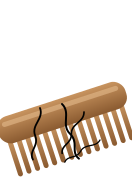
You clean the shower drain and find a little ball of hair. You wonder if that’s a lot. You even try counting, then give up. It’s a common question: how many hairs can you lose a day before you should worry?
The answer is a range, not a number. And what really matters shows up somewhere other than the drain.
The number and where it comes from
The French Society of Dermatology (SFD) puts it simply: normally, you lose between 50 and 100 hairs a day1. The NHS gives the same range and adds that you often lose them without noticing2.
The British Association of Dermatologists goes further and says 30 to 150 hairs a day for most people3. The gap between the two ranges already tells you something: there’s no standard down to the last hair. Depending on your hair, how you style it and the season, your normal isn’t the same as someone else’s.
Real measurements are rare, because counting your hair every day is tedious. One English team did it: 14 men aged 18 to 39, checked every 28 days for 18 months in Sheffield. At the height of the shedding, in August and September, they lost about 60 hairs a day, more than twice as many as the winter before4. It’s a small study, of men only, but it shows how much one person’s number moves over the year.
Why you lose hair every day
A hair doesn’t grow forever. It grows for several years, rests, then falls out to make room for a new hair from the same follicle, the small pocket in the skin it grows from1.
In the resting phase (the telogen phase), the hair has stopped growing. It stays in place for two to four months, then the new hair growing underneath pushes it out3. For that hair, falling out is the normal end of the cycle. Your total number of hairs stays about the same, since every hair lost is replaced3.
85 out of 100hairs are growing at any given time
15 out of 100are resting and will fall out in the coming months
30 to 150hairs lost a day: the normal range for most people
British Association of Dermatologists, 2025 patient leaflet3
As long as the hairs that fall are replaced at the same pace, your volume doesn’t change. It’s when the pace speeds up for weeks that the difference starts to show.
Why your number changes
From one day to the next, what you find in your brush or the shower doesn’t exactly reflect what fell out. British dermatologists note that shedding is mostly noticed after washing or brushing3. Shampoo carries away the hairs that were ready to fall. That’s why a test done shortly after a wash can look falsely reassuring (more on that below). If you wash your hair every three days, expect to see more on wash day.
The seasons play a part too. The SFD reports heavier shedding in spring and especially in autumn1, which matches the late-summer peak in the Sheffield study4.
Finally, some events push a lot of hairs into the resting phase at once. Those hairs then fall out in large numbers two to three months later. Dermatologists call this telogen effluvium. Classic triggers are giving birth, a high fever or severe emotional shock1, but also major weight loss, surgery or stopping the pill5. For one person in three, no cause is found3.
The two-to-three-month delay explains why people often look for the cause in the wrong place. Shedding in November can come from the flu you had at the end of summer.
When it’s too much
The clearest sign isn’t a number. It’s a sharp change from what’s usual for you: a lot more hair on the pillow in the morning, in the drain, in the brush, all of a sudden3.
During an effluvium, the share of resting hairs goes from 15% to 30% or more3, and up to half the hairs on your scalp can fall out6. It happens all over the head, without patches. What you mostly notice is thinner hair and less volume3.
This shedding phase usually lasts 3 to 6 months, then new hairs grow back. It often takes several more months to get your old thickness back3. The American Academy of Dermatology says normal fullness returns within six to nine months5.
At the doctor’s, the simplest test is to gently pull a small section of hair to see whether more hairs come out than usual. One useful detail: if you washed your hair in the 48 hours before, the test can look falsely reassuring3.
Shedding or hair loss: the difference
Dermatologists separate two things everyone mixes up. Shedding is when hairs fall out but grow back. Hair loss is when something stops the hair from growing5.
Heavy shedding is scary but usually leaves no trace. What shows over time is a loss of density in a specific area. DermNet lists two clues to female pattern hair loss, another cause of thinning hair: a widening part, and finer hair at the front and on top of the head6.
The two can overlap. An effluvium can reveal pattern hair loss that was already on its way, and sometimes both happen at the same time3. Only a dermatologist can tell them apart, and they can tell you whether you have shedding, hair loss or both5.
When to see a doctor
The first step is always an examination of your hair and scalp1. If pattern hair loss is starting, your doctor can offer you a treatment. The earlier it’s treated, the better the results5.
In the meantime, a few habits go easy on your hair: no vigorous brushing, less straightening and fewer blasts of very hot air, no tight hairstyles, and enough iron and protein in your diet3. They won’t stop an effluvium, which ends on its own, but they avoid adding breakage on top.
Count or photograph
Counting the hairs you lose is tempting, but it tells you little. The number depends on wash day, the season, the brush. And it says nothing about what matters: is your volume holding, is your part widening, is your hair growing back?
For that, a photo taken in the same conditions every week tells you more. Same room, same light, same distance, hair dry and styled the same way. Aim at your part, the crown and your forehead.
That’s the idea behind Calvap. Your last photo appears as a see-through overlay so you can line up in the same spot, and your photos are sorted by area, week after week. You see how things change instead of guessing. If you need to see a doctor, you bring dated photos, and the doctor does the interpreting.
Sources
- Société Française de Dermatologie (dermato-info): Tout savoir sur l’alopécie (in French)
- NHS: Hair loss
- British Association of Dermatologists: “Telogen effluvium” patient leaflet (updated October 2025)
- Randall V.A., Ebling F.J. Seasonal changes in human hair growth. British Journal of Dermatology, 1991
- American Academy of Dermatology: Do you have hair loss or hair shedding?
- DermNet: Telogen effluvium
Related reading
 Early signsThe early signs that go unnoticedThey come on slowly. You can have them for months before you notice.
 Hair and ageYour hair at 50: what’s normalFiner, lighter hair and a receding hairline: what age changes for almost everyone.
 MythsCaps, haircuts, the full moon: true or false?What dermatologists say about a few very common beliefs.