 Calvap
Growth · 6 min read
The hair growth cycle
Every hair grows, stops, rests and then falls out, on its own schedule. How long each phase lasts, and what can throw the whole thing off.
Calvap editorial team · Updated · 8 sources
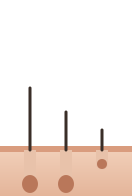
You pull off your jumper and find three hairs on the sleeve. The next morning, two more on the pillow. They fall out every day, and yet you’re not going bald. How does that work? The answer lies in a schedule that each hair follows on its own.
You have about 100,000 hairs on your head1. None of them is the same age as its neighbour, and that staggering is exactly what keeps your hair roughly constant.
The four phases of a hair
A hair grows out of a follicle, the small pocket in the skin where it’s rooted. That follicle doesn’t make the same hair for life: it works in cycles, and each cycle goes through four stages.
Growth, or the anagen phase. The follicle keeps producing the hair. On the scalp it lasts about two to eight years, by far the longest phase1. How long it lasts sets the maximum length your hair can reach: at about 1 cm a month1, a hair that grows for six years can pass 70 cm. Eyebrows only stay in growth for two to three months1, which is why they stay short.
Transition, or the catagen phase. The hair stops growing and the follicle shrinks back. It lasts about two weeks1.
Rest, or the telogen phase. The hair is still there, but it no longer grows. It stays in place for two to four months while a new hair starts growing underneath2.
Shedding, or the exogen phase. This is the end of the rest and the start of a new cycle: the new hair pushes the old one out12. For a long time, shedding was thought to be simply part of the resting phase. In 2002, a team showed in mice that it’s a separate stage with its own mechanism3.
A hair spends years growing and only a few months resting.
A single follicle goes through ten to thirty cycles in a lifetime1.
Where your hairs are right now
If you could freeze your head at this instant, you’d find about 85 hairs out of 100 actively growing and about 15 out of 100 resting, ready to fall out in the coming months2. Estimates vary between sources: a 2023 review puts the resting share closer to 9%1. The order of magnitude is the same.
Because each follicle has its own schedule, the shedding is spread out. The result: most people lose between 30 and 150 hairs a day, and the total number of hairs doesn’t change, since each one is replaced2. Those fallen hairs aren’t lost, then. They’re hairs that reached the end of their cycle.
The empty follicle, caught on camera
The four-phase model leaves one question open: does the new hair always arrive on time? To find out, a French team photographed the same small patch on the crown of ten men, roughly once a month, for eight to fourteen years. In those photos, every hair can be followed one by one. In total, almost 10,000 cycles were observed4.
This follow-up revealed a stage missing from the classic model. Often, after a hair falls out, the follicle stays empty for a while before a new hair appears. Italian dermatologists named this pause kenogen, from the Greek for “empty”. In these ten men, it affected 80% of cycles and lasted about 4 months, sometimes up to 75.
The study has its limits: only ten men, a single area of the scalp, and it was run by a cosmetics laboratory. Still, it shows something simple: a hair that falls out isn’t always replaced straight away.
What disrupts the cycle
The first case is a shock to the body. A high fever, surgery, crash dieting, giving birth, major stress, starting a new medicine or coming off the pill can push many hairs into the resting phase at once2. The share of resting hairs then rises from 15% to 30% or more, and they fall out together about 3 months later2. Dermatologists call this telogen effluvium. The shedding can affect up to half of the scalp hair6. For one person in three, no cause is found2. The shedding can come back if a cause such as iron deficiency isn’t treated, which is why it’s worth checking for deficiencies2.
Androgenetic alopecia works differently. In this type of hair loss, often inherited, the growth phase gets shorter with each cycle1. In someone without hair loss, there are about 12 to 14 growing hairs for every resting one; in androgenetic alopecia, that ratio drops to about 5 to 11. The French team’s photos also show hairs getting finer and follicles staying empty for longer between two hairs4. So fewer hairs are present at the same time.
Age plays a part too. In the same ten men, the growth phase got shorter and hairs got finer over the years, especially the thickest ones. The gap between one hair falling and the next appearing grew longer. These changes looked like those of androgenetic alopecia, only milder7.
Some treatments hit growth directly. The growth phase is the most sensitive to drugs and toxins; chemotherapy, for example, can rush hairs into the resting phase1.
Finally, the seasons. In these ten men, the share of resting hairs peaked at the end of summer and the start of autumn8. That’s one of the explanations for autumn shedding.
Why everything takes months
The cycle has one consequence everyone underestimates: nothing changes quickly. After telogen effluvium, the shedding phase usually lasts 3 to 6 months, then new hairs grow back. It often takes several more months to get your old thickness back2. DermNet puts the return to normal at around 6 to 9 months in most cases6.
The delay also muddies the trail. November shedding can come from a bout of flu at the end of summer. And when you change your hair care, any effect can only show at the pace of the cycle, so over months, not two weeks. Shedding that lasts more than 6 months is called chronic2: that’s the time to talk to a GP or a dermatologist.
Tracking your cycle with photos
The best study of the hair cycle didn’t count hairs in a brush. It took the same photo, in the same spot, month after month. That’s the only way to see a cycle that plays out over years.
You can do the same at home, more simply. One photo a week, same room, same light, hair dry. Aim at your parting, your crown and your temples: that’s where a shortening growth phase or regrowth after shedding shows first.
Calvap helps you retake it identically: your previous photo appears as a see-through overlay so you can line up in the same spot, and your photos sit on a timeline, area by area. After a few months, you can see whether your density is holding, dropping or coming back. Your photos stay on your phone.
Sources
- Natarelli N. et al. Integrative and mechanistic approach to the hair growth cycle and hair loss. Journal of Clinical Medicine, 2023
- British Association of Dermatologists: patient information leaflet “Telogen effluvium” (updated October 2025)
- Milner Y. et al. Exogen, shedding phase of the hair growth cycle: characterization of a mouse model. Journal of Investigative Dermatology, 2002
- Courtois M. et al. Hair cycle and alopecia. Skin Pharmacology, 1994
- Rebora A., Guarrera M. Kenogen. A new phase of the hair cycle? Dermatology, 2002
- DermNet: Telogen effluvium
- Courtois M. et al. Ageing and hair cycles. British Journal of Dermatology, 1995
- Courtois M. et al. Periodicity in the growth and shedding of hair. British Journal of Dermatology, 1996
Related reading
 Early signsThe early signs that go unnoticedThey come on slowly. You can have them for months before you notice.
 Hair and ageYour hair at 50: what’s normalFiner, lighter hair and a receding hairline: what age changes for almost everyone.
 MythsCaps, haircuts, the full moon: true or false?What dermatologists say about a few very common beliefs.