 Calvap
Microneedling · 7 min read
Microneedling for hair loss
A small roller covered in needles, run over the scalp to make hair grow back. The idea has one famous study behind it, and limits you hear about far less often.
Calvap editorial team · Updated · 9 sources
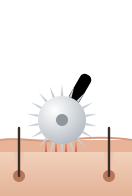
You come across a video: a man runs a small needle-covered roller over his scalp, then shows his before-and-after photos. The question comes on its own: does it really work, and could you do it in your own bathroom?
Microneedling has some science behind it, but less than the videos suggest. Here is what we know, study by study.
How it might work
The technique comes from treating scars and wrinkles. Very fine needles pierce the skin and create a controlled injury. As it repairs these micro-wounds, the skin releases growth factors that lead to new collagen and new small blood vessels6. Roller (the well-known dermaroller), stamp or electric pen: the tool changes, the principle stays the same.
For hair, these healing signals are thought to wake up the follicles. That is still a hypothesis. The other suggested effect is more down to earth: the micro-holes may help a lotion applied to the scalp to get in better. Spanish dermatologists mention this use in their 2024 consensus: microneedling can go alongside a topical treatment to improve its penetration7.
Microneedling has mostly been studied in androgenetic alopecia, common pattern hair loss, which is largely inherited. The American Academy of Dermatology (AAD) advises talking to a dermatologist before buying a device4.
The 2013 study that started it all
The study everyone quotes was run in Mumbai by a team of dermatologists (Dhurat and colleagues). A hundred men aged 20 to 35 with moderate hair loss were randomly split into two groups for 12 weeks. Both groups applied the same minoxidil lotion. One group also had a weekly microneedling session, with a 1.5 mm roller used until the skin turned slightly red1.
After 12 weeks, the microneedling group had gained an average of 91.4 hairs per cm², against 22.2 for the lotion alone. And 41 men out of 50 rated their hair as more than 50% better, against 2 out of 44 in the other group1.
But it was a “pilot” study. Only the assessor didn’t know who was in which group: the patients knew whether they were getting the needles. It only included young men, over just three months. And nobody tested microneedling without the lotion1. All it shows is that the two together did better than the lotion alone, in these men.
Later trials, less clear-cut
In 2018, an Indian team ran almost the same experiment on 68 men: the same lotion in both groups, a 1.5 mm roller on top for one of them, 12 weeks2. The microneedling group gained more hair, and every patient in it saw at least a small increase. But the researchers themselves conclude that the improvement, clear in the statistics, was not cosmetically significant2.
Same protocol, same length of time: the striking 2013 result was not repeated.
The 2018 authors offer one explanation: unlike in 2013, their patients’ heads were not shaved2. The hair may have got in the way of the needles.
A review published in 2022 brought together 22 studies covering 1,127 people3. Its authors find the results “generally favorable” for microneedling as an add-on to another treatment, but say the data are “of relatively low quality”. The studies are small, varied, almost all shorter than a year, and few test microneedling on its own3. In Spain, dermatologists could not agree on several recommendations about microneedling, for lack of evidence7.
Compared with other in-clinic options such as PRP sessions, microneedling still has no long, solid trial behind it.
What people who tried it say
On a hair loss forum, the tone is a long way from the videos8.
“I’ve tried it about 10 different ways; it’s negligible at best.”
“it makes my scalp very itchy which never happened before.”
Testimonials posted on the HairLossTalk forum8.
Which needle length
It’s the most common question, and nobody knows the answer. In studies on pattern hair loss, needles ranged from 0.25 to 2.5 mm, with an average of 1.39 mm3. The review’s authors conclude that no best practice can be set yet3.
A few pointers all the same:
- The AAD notes that devices for hair use longer needles than those for facial skin4.
- The stated length isn’t the depth reached: a 1.25 to 1.5 mm roller is estimated to go about as deep as a pen set to 0.6 to 0.8 mm3.
- In one study, a pen set to 0.6 mm did better than one set to 1.2 mm3. Longer isn’t necessarily better.
- On the other hand, a 0.25 mm stamp used at home twice a week made no difference to hair3.
The schedule varies too: from twice a week to once a month depending on the study, over 20 weeks on average3.
The risks, hygiene above all
Done properly, microneedling is well tolerated: among 657 people treated in the studies, no serious side effects were reported, mostly brief pain, redness, irritation and itching3.
What worries dermatologists is hygiene. Each session opens thousands of tiny entry points in the skin. The US Food and Drug Administration (FDA) lists possible effects including bleeding, bruising, crusting, redness and, less often, infection or a cold sore flare-up. It states plainly that re-using a needle cartridge is unsafe5. DermNet adds that poor-quality tools can break in the skin, and that lumpy reactions have been described, sometimes linked to a product applied or to a nickel allergy6.
At home or in a clinic
In the US, the FDA has authorised microneedling devices for facial acne scars, facial wrinkles and abdominal scars, in people aged 22 and over5. Hair isn’t on the list.
At home, the risk of infection is higher. A dermatologist quoted by the AAD calls at-home dermarolling dangerous, because of infections and poor technique9. DermNet describes home models with very short needles, around 0.2 mm6: less risky, but that is exactly the kind of length that did nothing for hair in the studies3.
In a clinic, the FDA suggests asking the practitioner about their training, how the device is cleaned and whether a new cartridge is used for every session5. First of all, you need to know what kind of hair loss you have: the right doctor to see can name it, and your doctor can offer you a treatment that has been studied far more than needles alone.
Judging the effect in photos
In the studies, the effect is measured in hairs per cm², on photos with the same framing. At home, the mirror is the judge, and a poor one: your scalp is red after a session, the light changes, and the hairs you lose every day have nothing to do with the needles.
To know whether anything is changing, you need comparable photos, taken well away from sessions: same room, same light, same distance, dry hair. Aim at the crown and the parting, where the trials measured. And give it at least three months, the length of the studies, before you decide.
That is what Calvap does: one photo a week, guided by a ghost of the previous one so you keep the same angle, with your sessions logged in your journal on the same timeline. After three months, you put week 1 next to week 12 and see whether the roller has done anything.
Sources
- Dhurat R. et al. A randomized evaluator blinded study of effect of microneedling in androgenetic alopecia: a pilot study. International Journal of Trichology, 2013
- Kumar M.K. et al. A randomized controlled, single-observer blinded study… topical minoxidil plus microneedling versus topical minoxidil alone. Journal of Cutaneous and Aesthetic Surgery, 2018
- English R.S. et al. Microneedling and its use in hair loss disorders: a systematic review. Dermatology and Therapy, 2022
- American Academy of Dermatology: Hair loss: diagnosis and treatment
- FDA: Microneedling devices
- DermNet: Skin needling
- Spanish Academy of Dermatology consensus on androgenetic alopecia (Vañó-Galván et al., Actas Dermo-Sifiliográficas, 2024)
- HairLossTalk forum: “Microneedling for hair loss” (testimonials)
- American Academy of Dermatology: 5 unsafe skin care trends to avoid