 Calvap
Red light · 6 min read
Red light helmets: do they work?
A helmet that lights up red, twenty minutes on your head, and thicker hair a few months later. The trials partly back up the promise. The rest is in the small print.
Calvap editorial team · Updated · 8 sources
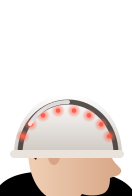
An ad pops up in your feed: someone puts on a helmet that lights up with little red dots, like a prop from a science-fiction film. Twenty minutes, a few times a week, and thicker hair promised within a few months. The price is no small matter. Before you reach for your card, one question: does light really make hair grow?
The short answer: a little, for some people, in trials that rarely last more than six months. Here are the details.
Where the idea came from
It came about by chance. Some people having laser hair removal saw hair growing, the opposite of what they wanted, around the edges of the treated areas1. Hence the idea of shining light on the scalp.
The helmets, caps and combs sold for hair loss use what is called photobiomodulation, or low-level laser therapy: red or near-infrared light, too weak to heat or burn. According to the European guideline, nobody fully understands how it works. It is thought to stimulate cell growth, through growth factors and better blood flow in the skin1.
These devices have been tested in androgenetic alopecia, common pattern hair loss, which is largely inherited: the hairline and crown in men, a widening parting in women.
What the trials show
Serious studies compare a real device with a sham one that looks identical but doesn’t give off the right light. Neither the participant nor the assessor knows which is which.
A Korean trial published in 2020 tested this kind of helmet in 60 adults, men and women. They wore it at home for 25 minutes every other day for 16 weeks2.
The real helmet did clearly better than the sham one.
Hair was also slightly thicker in the treated group. But participants’ satisfaction was not significantly different between the two groups, and the study was funded by the manufacturer2. The authors themselves mention short follow-up and a small sample2.
Other trials point the same way. In 123 men, a laser comb used for 26 weeks added an average of 19.8 hairs per cm², while the sham comb group lost 7.61. In 47 women, a device increased hair counts by 48.7% over 16 weeks, against 11% with a sham1.
A 2021 meta-analysis pooled 7 trials of this kind, 607 people in all, every one using a home device3. It confirms an effect on density, with no clear difference between men and women or between combs and helmets. Devices with laser diodes only did better than those mixing LEDs and lasers3. Its limits: no follow-up beyond 26 weeks, small trials, and advanced hair loss never studied3.
“FDA cleared”: what it means
The phrase is on almost every box. The first device, a laser comb, got the go-ahead from the US agency in January 20074. By January 2020, 32 home-use devices had reached the market this way3.
But this is usually through a procedure called a 510(k). The manufacturer has to show that its device is “substantially equivalent” to one already legally on the market; the FDA then “clears” it for sale5. It is a separate route from premarket approval, the FDA’s other procedure, and the data supplied can come from patient studies or from bench testing5. The 2021 meta-analysis also notes that some cleared devices have very few published studies on how well they work3.
In other words, “FDA cleared” tells you the device can be sold in the US. It doesn’t tell you it works as well as the one in the trial you read about.
What dermatologists say
The 2018 European guideline suggests low-level light as an add-on treatment for pattern hair loss, on one condition: using a device whose energy level has proved effective in trials1. It makes no recommendation either way beyond six months, for lack of longer follow-up1.
Spanish dermatologists, in 2024, describe its effect as proven but highly variable, to be decided case by case. They did not agree on the best regimen, but consider that at least three sessions a week are needed to judge the effect6. In the US, the AAD calls the results promising while pointing out that not everyone who used a laser saw regrowth8.
What users say
On a hair loss forum, a man asked for honest reviews of these caps, fed up with fake ones. The replies go in every direction7.
“It may help you hold on to what you have and slow down the loss”
“Honestly I can’t tell whether it’s providing any benefit or not.”
“it just didn’t help prevent hair loss in the duration I used it.”
Testimonials posted on the HairLossTalk forum7.
What to expect
- Consistency matters: the AAD warns that you may need several sessions a week for many months to see a bit of growth8.
- The effect varies from one person to the next6, and trials measure it in tens of hairs per cm², not in a full head of hair regained2.
- Side effects are usually mild: the European guideline mainly lists a dry scalp, itching, tenderness and a feeling of warmth1.
- Buying one is expensive: in 2020, device prices ranged from just under 300 to nearly 3,000 dollars, depending on the number of diodes and the features3.
These devices have not been properly compared with standard treatments1. If your hair loss is progressing, the right doctor to see can first find the cause, and your doctor can offer you a treatment. Light can then come on top, as dermatologists suggest. If you are weighing it against another add-on, compare it with what we know about microneedling.
Judging the effect in photos
A helmet is judged over months, and that is where the mirror lets you down. You paid a lot and you spend twenty minutes under it several times a week: you want to see a result, and you end up seeing one, or none at all, depending on the day. As for the hairs you lose every day, they say nothing about density.
The trials measure on photos taken in the same spot, the same way, at 16 or 26 weeks. Do the same with comparable photos: same room, same light, same distance, dry hair, with the crown or parting clearly visible.
Calvap guides you to take that photo every week, with a ghost of the previous one so you keep the same angle. Your helmet sessions go in your journal, on the same timeline. After four to six months, the length of the trials, you put week 1 next to week 24 and you know whether your helmet is worth its price.
Sources
- European S3 guideline on androgenetic alopecia, 2018 update (Kanti et al., EDF)
- Yoon J.S. et al. Low-level light therapy using a helmet-type device for the treatment of androgenetic alopecia: a 16-week, multicenter, randomized, double-blind, sham device-controlled trial. Medicine, 2020
- Lueangarun S. et al. A systematic review and meta-analysis of randomized controlled trials of FDA-approved, home-use low-level light/laser therapy devices for pattern hair loss. Journal of Clinical and Aesthetic Dermatology, 2021
- FDA 510(k) database: file K060305, laser comb for pattern hair loss (01/2007)
- FDA: Premarket Notification 510(k)
- Spanish Academy of Dermatology (AEDV) consensus on androgenetic alopecia (Vañó-Galván et al., Actas Dermo-Sifiliográficas, 2024)
- HairLossTalk forum: “Laser caps, has anyone had positive reviews?” (testimonials)
- American Academy of Dermatology: Hair loss: diagnosis and treatment