 Calvap
Pregnancy · 5 min read
That late-pregnancy volume
Many pregnant women find their hair gets thicker. It isn’t your imagination, and it doesn’t last. What’s going on, what else changes, and what to check.
Calvap editorial team · Updated · 7 sources
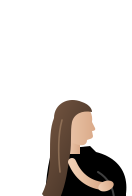
Seven months in. Your ponytail has doubled in size, the hair tie goes round one time fewer, and your hairdresser says you’ve got “a lot of hair” at the moment. In the shower, the plughole stays almost clean. You’re not imagining it: many pregnant women find their hair gets thicker, especially towards the end1.
There’s a simple explanation for this volume, it has a predictable end, and it comes with other changes to your skin and body hair. Here’s what’s happening, and what’s worth checking during these months.
Why less hair falls out
Hair lives in cycles. Each hair grows for several years (the growth phase, or anagen), rests for a few months, then falls out to make room for a new one. Normally, that means losing 50 to 100 hairs a day1. For the details, read how the hair growth cycle works.
In the third trimester, a bigger share of your hairs stays in the growth phase2. Fewer hairs move into the resting phase, so fewer fall out. They build up and your hair looks fuller. The French Society of Dermatology (SFD) places this extra density in the second half of pregnancy1.
The driver is oestrogen, a hormone that runs much higher during pregnancy. It plays a key role in the hair cycle, and higher levels favour the growth phase3. Nothing new is really growing: mostly, hairs that should have fallen out are staying put.
Slightly thicker hairs, too
It isn’t just more hairs. A 2003 Israeli study suggests each hair gets a little thicker. The researchers measured the diameter of 15 to 20 hairs, centimetre by centimetre, in 12 pregnant women and 13 women who weren’t pregnant4.
In the pregnant women, the diameter started increasing from the beginning of pregnancy, by about 0.6% per centimetre of hair moving towards the scalp. In the others, it decreased by roughly the same amount, which is the usual pattern4. It’s a small effect, but it adds to the reduced shedding.
The limits are clear: 25 women in total, a single team, and a measure of diameter, not of the fullness you see in the mirror. The authors present their finding as a first description, not as definitive proof.
Early on, sometimes the opposite
This volume doesn’t arrive straight away. Early in pregnancy, you may actually shed more1.
If you’re losing a lot of hair during pregnancy, or you feel very tired, talk to your doctor or midwife. A blood test can look for iron deficiency, which is common in women, a thyroid problem, or low vitamin D or B121. Before reaching for supplements, it’s worth knowing which deficiencies really cause hair loss.
Body hair, skin, nails: the rest of you changes too
The same hormones act elsewhere. Fine, downy hair can appear, especially along the middle of the lower belly. These soft, fine hairs often go around six months after the birth, but coarser hairs usually stay2. In the second half of pregnancy, darker hairs can also grow on the face, especially in women with dark hair2.
If they come with acne or other unusual signs, mention it to your doctor: it’s rare, but a hormonal cause then needs looking into2.
90%of pregnant women get a dark line down the belly, which fades after the birth
70%get brown patches on the face (melasma) in the second half of pregnancy
Up to 90%get stretch marks, in the second and third trimesters
DermNet, Skin changes in pregnancy.2
Melasma usually fades completely after the birth, and strict sun protection helps prevent it2. Nails, meanwhile, often become more brittle2.
After the birth
When oestrogen drops, the hairs kept during pregnancy fall out together. Many new mothers notice clear shedding a few months after giving birth, peaking at around four months5. Most get their usual fullness back before their child’s first birthday, often sooner5.
The month-by-month timeline, the figures and what helps are all in our article on hair loss after giving birth. Remember one thing: this isn’t permanent hair loss, it’s your pregnancy volume leaving.
What to check during pregnancy
Some hair loss treatments are contraindicated in pregnancy, and others don’t have enough data to be considered safe6. That includes prescription medicines, but also some lotions sold in pharmacies without a prescription. While breastfeeding, the same caution applies: ask before using a product.
- If you were on a hair loss treatment before getting pregnant, don’t wait: talk to your doctor, midwife or pharmacist.
- Before any “anti-hair loss” lotion, serum or supplement, read the leaflet and ask their advice.
- If your hair is clearly thinning in places, a doctor can tell it apart from hormonal or inherited hair loss and suggest the right care after the birth.
On hair dye, the NHS is reassuring. Most research shows it’s safe while pregnant, because the chemicals only cause harm at very high doses and your scalp doesn’t absorb much7. A few precautions lower the risk further7:
- wait until after the first 12 weeks, if you’d rather;
- do a strand test, because your hair may react differently from usual;
- wear gloves, open a window, leave the dye on for the minimum time and rinse well;
- go for highlights, which don’t touch the scalp.
Keeping a record of your volume
Late pregnancy is when your hair is at its fullest. That also makes it a good starting point. A few photos taken now will be your reference when the shedding comes, a few months after the birth.
With Calvap, you take the same photo every week, framed the same way thanks to your previous photo shown as a see-through overlay. Parting, crown, temples: each zone lines up on a timeline. After the birth, you’ll see the shedding and then the regrowth, zone by zone, instead of trusting the mirror. And if your fullness is slow to come back, you can show your doctor dated photos.
Sources
- Société Française de Dermatologie (dermato-info): all about alopecia (in French)
- DermNet: Skin changes in pregnancy
- Kamp E. et al. Menopause, skin and common dermatoses. Part 1: hair disorders. Clinical and Experimental Dermatology, 2022
- Nissimov J., Elchalal U. Scalp hair diameter increases during pregnancy. Clinical and Experimental Dermatology, 2003
- American Academy of Dermatology: Hair loss in new moms
- Brinks A.L. et al. Safety and clinical considerations of alopecia therapies during pregnancy, fertility treatment, and polycystic ovary syndrome workup. International Journal of Women’s Dermatology, 2026
- NHS: Using hair dye in pregnancy: is it safe?
Related reading
 PregnancyHair loss after giving birthCommon in the months after the birth, and temporary.
 ThyroidThyroid problems and hair lossA thyroid problem can make your hair fall out. But the shedding often shows months later.
 Hair loss in womenHair loss in women: where it comes fromIn women, hair loss most often has a temporary cause.