 Calvap
Hairstyles · 6 min read
When your bun pulls too hard
A hairstyle that pulls hard, day after day, can thin your hairline and temples. Caught early, this hair loss can be turned around. The signs to watch for and the habits that protect you.
Calvap editorial team · Updated · 6 sources
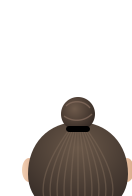
In the evening, you take your bun down and your scalp breathes a sigh of relief. It pulls, it stings, sometimes it aches right up to your forehead. Then one day, in a photo taken with your hair tied back, you notice your temples look thinner than before. Can a hairstyle really be to blame?
Yes. And it’s one of the few kinds of hair loss you can prevent, as long as you spot it early.
When a hairstyle makes hair fall out
A hairstyle that pulls too hard, worn often, can make hair fall out where it pulls1. Dermatologists call this traction alopecia: the hair doesn’t fall out because it’s unhealthy, but because it’s being pulled, hard and for a long time.
It mostly affects the front and sides of the scalp, where the tension is strongest, but the area depends on how you style your hair2. It can affect anyone, whatever their background or age, and becomes more common over the years as styling habits add up2.
At first, the skin turns red around the hair roots. Over the years, the condition can damage the follicle, the small pocket the hair grows from, until it leaves a scar3.
The hairstyles that pull the most
The American Academy of Dermatology lists styles worn too tight1:
- buns, ponytails and updos pulled tight;
- tight braids, cornrows and locs;
- extensions and weaves, especially on relaxed hair;
- rollers worn to bed most nights.
Weight matters too: very long hair or long braids pull harder12. A headscarf or other covering can add friction, especially if your hair is pulled back tightly underneath1. Jobs and practices that call for a strict bun play a part as well: a 2018 review describes a dancer who wore an uncomfortably tight bun to class four days a week for 13 years3. Sikh men who knot their hair tightly at the front of the scalp can also be affected3.
Relaxed hair is a special case. Chemically treated hair is more fragile, and the risk goes up when you add a style that pulls3.
Nearly one woman in three, and almost one person in two with extensions on relaxed hair.
This study examined the scalps of 874 adults in the Cape Town area. Traction alopecia affected 31.7% of the women, against 2.2% of the men, most of whom wore their hair natural. It peaked at 48% when the usual hairstyle was extensions attached to relaxed hair4. It’s a snapshot at one point in time, in a population with Afro-textured hair where these styles are very common. It doesn’t say that every braid makes hair fall out, but it shows what years of pulling can do.
A further analysis by the same team, covering 574 schoolgirls and 604 women, put a figure on the risk: compared with natural hair, adding a style that pulls to relaxed hair made traction alopecia roughly 3.5 times more likely5.
The first signs
The first warning sign is pain. In the South African study, only 18.9% of people with traction alopecia had never had any discomfort from their hairstyles5. In other words, the vast majority had felt pain, stinging or spots, often without paying it much attention.
The American Academy of Dermatology advises changing your hairstyle straight away if you notice1:
- pain when your hair is pulled;
- stinging or scabs on your scalp;
- “tenting”, where the skin is pulled up like a little tent where the hair is tied.
The very first visible sign is often redness around the hair roots, which can turn into small spots3. Then come broken hairs around the forehead, a receding hairline and thinning patches where the style pulls1.
One detail helps dermatologists: often, a row of fine hairs is left right at the edge of the thinned area. They call it the fringe sign3. It’s a useful clue, because a receding hairline can have other causes, such as female pattern hair loss or other scalp conditions.
Does it grow back?
Early on, it usually does. As long as the follicle is intact, there’s no scarring2, and most cases can be reversed if they’re caught early3. The heart of treatment is taking the tension off the hair3.
If the pulling goes on for years, the tension ends up destroying the follicles and the hair loss becomes permanent2. At that stage, the hair cannot grow back1. There’s no set time that marks the line between the two, which is why it all comes down to staying alert3. To understand the difference between a resting follicle and a destroyed one, see what grows back and what doesn’t.
Keeping your styles without losing your temples
Nobody is asking you to give up braids or buns. It’s about controlling the tension. The American Academy of Dermatology’s advice1:
- loosen your style, especially along your hairline and temples;
- go for thicker braids and locs, and keep them on the short side;
- don’t keep braids in for more than 6 to 8 weeks;
- wear weaves for short periods, choose sewn-in rather than glued, and take them out as soon as they hurt;
- switch styles and give your hair regular breaks from styling;
- under a headscarf or other covering, tie your hair back loosely; silk or satin is gentler.
For relaxed hair, the researchers’ rule fits in one line: no braids or weaves on relaxed hair3. And on an area that’s already thinning, avoid chemicals and heat2. Gentle habits with the hairdryer and straighteners point the same way.
When to see a doctor
According to the American Academy of Dermatology, it’s never too early to see a dermatologist1. Your doctor may offer you a treatment to calm the inflammation or help regrowth, and check that another cause isn’t adding to it. If you’re not sure who to turn to, here’s which doctor to see.
Watching your hairline with photos
Traction alopecia builds up over years, not overnight2. In the mirror, you can’t see your hairline move. The Cape Town researchers understood this well: to measure how severe traction alopecia is, they built a scale based on reference photos. In a small group of patients, comparing against photos gave scores that agreed better between examiners than a simple estimate by eye6.
At home, the method is the same. One photo of your forehead and one of each temple, hair pulled back the same way, same light, same framing. Once a week is enough. If you’ve just loosened your styles, these photos show you whether the little hairs are coming back along the edges.
Calvap shows your previous photo as a see-through overlay so you can line up in exactly the same spot, and puts your forehead and temple photos on a timeline. You see your hairline move forward or back, month after month, instead of going on a hunch. Your photos stay on your phone.
Sources
- American Academy of Dermatology: Hairstyles that pull can lead to hair loss
- DermNet: Traction alopecia
- Billero V., Miteva M. Traction alopecia: the root of the problem. Clinical, Cosmetic and Investigational Dermatology, 2018
- Khumalo N.P. et al. Hairdressing and the prevalence of scalp disease in African adults. British Journal of Dermatology, 2007
- Khumalo N.P. et al. Determinants of marginal traction alopecia in African girls and women. Journal of the American Academy of Dermatology, 2008
- Khumalo N.P. et al. Marginal traction alopecia severity score: development and test of reliability. Journal of Cosmetic Dermatology, 2007
Related reading
 PregnancyHair loss after giving birthCommon in the months after the birth, and temporary.
 PregnancyThat late-pregnancy volumeMany pregnant women find their hair gets thicker. It isn’t your imagination, and it doesn’t last.
 ThyroidThyroid problems and hair lossA thyroid problem can make your hair fall out. But the shedding often shows months later.